Cessna Citation Mustang vs C550: Which light jet wins for your business missions?
Business travelers invest billions annually in private aviation charters. Selecting the optimal light jet is a crucial financial and operational choice. This data-driven comparison analyzes two dominant models to determine the better value.
These aircraft represent different eras in aviation design. The first is a modern very light jet, optimized for efficiency and lower operating costs. The second is a classic light jet, engineered for greater passenger capacity and extended range.
This professional review cuts through the specs. It provides a clear analysis of passenger capacity, operational range, charter and ownership costs, cabin comfort, and key performance metrics. The goal is to deliver actionable insights for informed decision-making.
Structured with detailed tables and practical frameworks, the article serves owner-operators, charter clients, and flight departments. It matches each aircraft’s distinct strengths to specific business travel missions and requirements.
Mustang vs C550: Quick Decision Guide
- Mission Match: Mustang perfect for 2-4 pax short hops (1,125nm). C550 dominates 6-8 pax regional flights (1,998nm).
- Cost Leader: Mustang $2K-2.8K/hr vs C550 $2.5K-3.5K/hr. Empty legs save 75% on both via Villiers.
- Cabin Reality: Mustang compact 10ft vs C550 spacious 16ft (12 windows). Match to your passenger count.
- Live Solution: Villiers Jets compares both models instantly across 10,000+ aircraft network.
- Your Next Step: Request Villiers live quote → see exact pricing/availability for your NYC-MIA route today.
Executive Summary & Key Metrics
Data-driven analysis begins with a side-by-side review of capacity, distance, and economics. The following executive summary distills the most critical specifications for business aviation decision-makers.
Comparison Table: Capacity, Range & Cost
| Specification | Citation Mustang | Citation C550 WINNER |
|---|---|---|
| Passenger Capacity | 4-5 | 7-8 |
| Range (Nautical Miles) | 1,125 nm | 1,998 nm |
| Charter Cost ($/hr) | $2,000 – $2,800 | $2,500 – $3,500 |
| Max Takeoff Weight | 8,645 lb | 14,800 lb |
| Cruise Speed | 339 knots | 326 knots |
Villiers Jets → Compare Both Jets Now
Highlighting Key Specifications for Business Travelers
The table reveals a clear mission split. The smaller jet suits short-hop executive transport for smaller teams. Its lower hourly price is a key advantage.
The larger model nearly doubles the operational range. It also carries significantly more passengers and payload. This makes it ideal for group travel and longer business missions.
Both aircraft offer similar high-altitude performance and service ceilings. The takeoff weight difference highlights the substantial size gap between these two popular light jets.
Cabin Comparison: Space, Windows & Comfort
Beyond performance numbers, the cabin environment directly impacts productivity and comfort during flight. This analysis examines interior space, layout, and passenger amenities.
Interior Dimensions & Cabin Layouts
The smaller jet offers a cabin length of approximately 10.3 feet. Its height and width are both near 4.5 feet. The larger model provides a spacious cabin, measuring 16 feet in length.
| Feature | Very Light Jet (Citation Mustang) |
Light Jet WINNER (Citation C550) |
|---|---|---|
| Cabin Length (feet) | 10.3 | 16.0 |
| Cabin Height (feet) | 4.5 | 4.5 |
| Standard Seating | 4 | 7-8 |
| Baggage Volume (cubic feet) |
57 | N/A |
Villiers Jets → See Interior Photos Now
The four-seat club configuration features aft-facing reclining seats. Forward seats against the bulkhead do not recline. An emergency toilet is discreetly placed behind a curtain.
Total baggage space is a notable 57 cubic feet. This includes aft and nose compartments. It is exceptional for a very light jet.
Feature Comparison: Windows, Seating & Amenities
Both cabins include modern LED lighting and stowable work tables. Ergonomically designed leather seats feature AC power ports for devices.
The larger aircraft typically has twelve windows. This allows abundant natural light into the cabin. The longer fuselage creates a more open and comfortable feel for passengers.
Refreshment storage and multiple cup holders are standard. Advanced climate control systems maintain a comfortable cabin pressure throughout the flight.
Performance Overview & Technical Data
Aircraft performance metrics translate directly into access, speed, and efficiency for travelers. This analysis breaks down the engine power and flight characteristics that define each jet’s operational capability.
Takeoff Distance, Cruise Speed, and Engine Specifications
Engine thrust is a foundational performance metric. The very light jet is powered by two Pratt & Whitney Canada PW615F turbofans. Each produces 1,460 lbf of thrust.
The classic light jet uses two Pratt & Whitney Canada JT15D-4 engines. Each generates 2,500 lbf. This gives it a significant 71% total thrust advantage.
This power difference impacts runway needs. The smaller model requires only 3,110 feet for takeoff. Its landing distance is just 2,380 feet.
Cruise speed is remarkably similar. The lighter jet typically flies at 339 knots. The larger one cruises at 326 knots.
Both aircraft exhibit an excellent rate of climb, near 3,000 feet per minute. They also reach high service ceilings for efficient flight.
Comparative Performance Tables
The following table provides a direct data comparison for key metrics.
| Specification | Very Light Jet (Citation Mustang) |
Light Jet (Citation C550) |
|---|---|---|
| Total Engine Thrust | 2,920 lbf | 5,000 lbf |
| Takeoff Distance | 3,110 ft | 3,600 ft |
| Landing Distance | 2,380 ft | 2,700 ft |
| Typical Cruise Speed | 339 kts | 326 kts |
| Rate of Climb | 3,010 fpm | 3,040 fpm |
Villiers Jets → Check Runway Compatibility
Both powerplants feature advanced FADEC systems. The greater thrust of the larger jet supports its increased payload and range, despite needing slightly more runway.
Cost Analysis & Flight Economics
The true value of a light jet is measured by its operational economics and total cost of ownership. This analysis examines specific route pricing and long-term financial commitments for private jet operations.
NYC-MIA Pricing & Empty Leg Savings
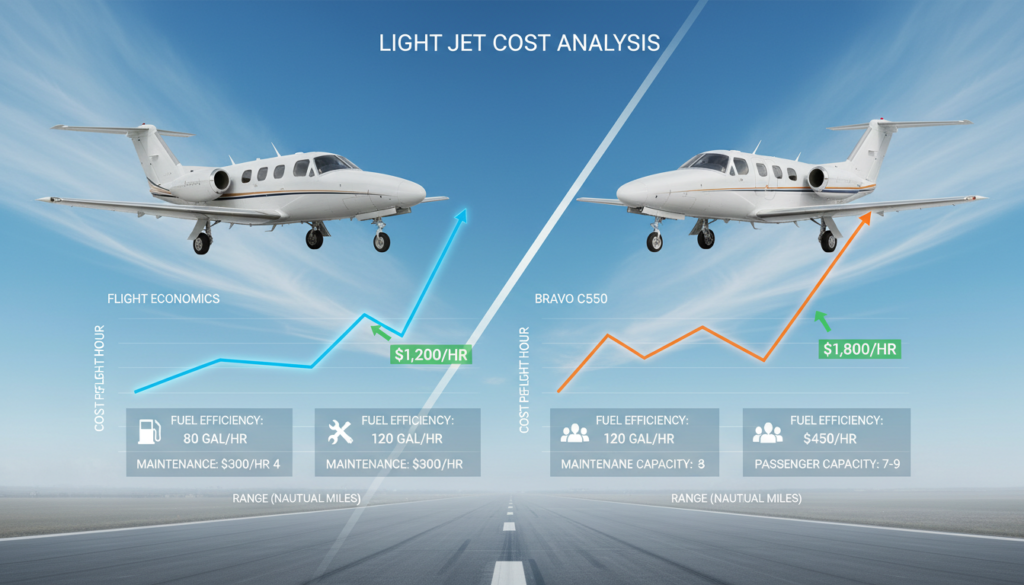
A flight from New York to Miami covers about 1,090 nautical miles. Charter price for the complete trip typically ranges from $6,250 to $8,400 for the smaller model.
The larger aircraft costs $7,500 to $10,500 for the same route. This reflects its higher hourly rate but greater passenger capacity.
💰 SAVE 75% WITH EMPTY LEGS
🎯 VIEW LIVE EMPTY LEG DEALSEmpty leg savings of approximately 75% fundamentally change the flight cost equation. Charter service providers offer these one-way discounts.
Long-Term Operating Costs
Jet ownership involves significant capital outlay. Used models for the smaller type command $1.5-2.5 million in today’s market.
Annual costs include depreciation, maintenance, and crew salaries. Fuel consumption for the smaller jet runs about 95 gallons per hour.
This translates to roughly $500-600 per flight hour. Over five to ten years, the total operating cost per nautical mile favors the smaller jet for short trips with fewer passengers.
The larger business jet offers better economics when carrying full groups on longer missions. Careful analysis of utilization rates is key for private jet value.
Detailed Cessna Citation Mustang vs C550 comparison
The fundamental engineering choices behind these two models create distinct advantages for different travel missions.
Design, Capacity and Range Contrasts
The 2006 very light jet entry was optimized for efficiency and owner-operators. It offers an intimate cabin for four to five passengers. This design excels at regional business travel.
The classic light jet from 1977 prioritizes capacity and versatility. It comfortably carries seven or eight people. Its nearly 2,000 nautical mile range enables true cross-country flights.
This range differential is critical. The smaller model may require a fuel stop on longer U.S. routes. The larger aircraft can complete many trips non-stop.
Impact of Cost & Performance on Business Travel
Weight specifications directly influence capability. The lighter aircraft has an empty weight of 5,600 pounds. This allows superb short-field performance and lower direct costs.
The heavier model’s structure supports greater payload flexibility. Both jet types reach high altitude, flying above weather. Their cruise efficiency is best with the right passenger load.
Operational flexibility also differs. The very light jet can access thousands more airports. For business travelers, matching the aircraft’s core performance to the mission is the key to value.
Villiers Jets Comparison & Calls-to-Action
The decision between two capable aircraft is best informed by a platform that contextualizes them within a global network. Villiers Jets provides this critical live marketplace.
It offers access to over 10,000 private jets worldwide. Travelers can compare real-time availability and pricing in one dashboard.
Live Comparison with 10,000+ Aircraft Data
The platform’s technology enables instant searches. Users see which light jet models are available near their departure city.
A live comparison feature displays specs side-by-side. This includes current pricing, interior configuration, and aircraft age.

The empty leg marketplace lists discounted one-way flight options. Savings can reach up to 75% when travel plans align with aircraft positioning.
The table below outlines key platform benefits.
| Villiers Jets Feature | Traveler Benefit | Decision Impact |
|---|---|---|
| Live Aircraft Comparison | Side-by-side specs & real-time pricing | Informed model selection |
| Empty Leg Marketplace | Up to 75% cost savings | Better trip economics |
| Dedicated Aviation Advisor | Personalized service throughout | Streamlined booking process |
| Safety Vetting Protocol | Verified aircraft standards | Travel peace of mind |
🔥 10,000+ AIRCRAFT NETWORK
Live comparison of Mustang vs C550 for your exact route
COMPARE BOTH JETS LIVE →How to Engage with Villiers Jets Offers
Engagement begins with a custom quote request. Aviation advisors provide route-specific recommendations on the best business jet for your mission.
Membership programs offer guaranteed availability and preferred pricing. The concierge service handles ground transport and catering.
For a seamless experience, request a live quote today. Compare specific light jet options for your next flight.
Decision Matrix for Business Travelers
Selecting the optimal aircraft requires matching specific travel missions to distinct aircraft capabilities. A structured decision framework clarifies which model delivers superior value.
Evaluating Short-Hops vs. Group Travel Needs
The core choice hinges on mission distance and passenger count. Short regional flights under 600 nautical miles favor one model. Longer trips with larger groups benefit from another.
| Decision Factor | 🏆 Optimal for Short-Hops (Mustang) |
🏆 Optimal for Group Travel (C550) |
|---|---|---|
| Primary Mission | Under 500 nm 2-4 passengers |
Over 900 nm 6-8 passengers |
| Cost Per Passenger | $625-700/hr (4 pax) |
$312-437/hr (8 pax) |
| Runway Requirement | 3,110 ft takeoff | 3,600 ft takeoff |
| Operational Flexibility | Access to regional airports | Non-stop continental range |
⚡ YOUR PERFECT JET MATCH
Villiers instantly compares both jets for your route + shows live empty leg deals
FIND YOUR JET NOW →Aircraft Suitability and Practical Scenarios
A CEO shuttling between nearby offices needs efficiency. The citation mustang excels here with lower operating costs.
Transporting a full team across the country demands space and range. The C550’s larger cabin and nearly 2,000 nm capability are ideal.
Runway access is critical. The cessna citation with shorter landing distance reaches more airports. This reduces ground time for executives.
For owner-pilots, simpler systems and lower crew needs make one jet attractive. The other typically requires a professional crew for optimal performance.
Conclusion
Choosing the right light jet ultimately depends on aligning its core capabilities with your specific travel requirements. This professional comparison confirms both aircraft serve distinct business aviation segments with clear, complementary strengths.
The fundamental decision hinges on passenger capacity and mission range. One model offers a compact cabin ideal for short-hop efficiency with small teams. The other provides a spacious cabin and nearly double the operational range for group travel.
Performance aloft is notably similar, with both jets reaching high altitude and maintaining comparable cruise speed. Key practical differences include landing distance and maximum takeoff weight, affecting airport access.
For the best value, match the aircraft’s primary advantages to your most common mission profile. Leveraging live market tools can provide real-time availability and cost data for informed selection.